
What is commerce, and how do products reach us from factories and farms? How does a packet of biscuits reach your nearby grocery store, or how does a mobile phone manufactured in another country become available in India?
The answer is commerce. It connects producers with consumers and makes the exchange and distribution of goods and services possible.
Commerce is not just buying and selling. It also includes services such as transportation, banking, insurance and warehousing that support trade. Let’s understand its meaning, components, characteristics, functions and importance.
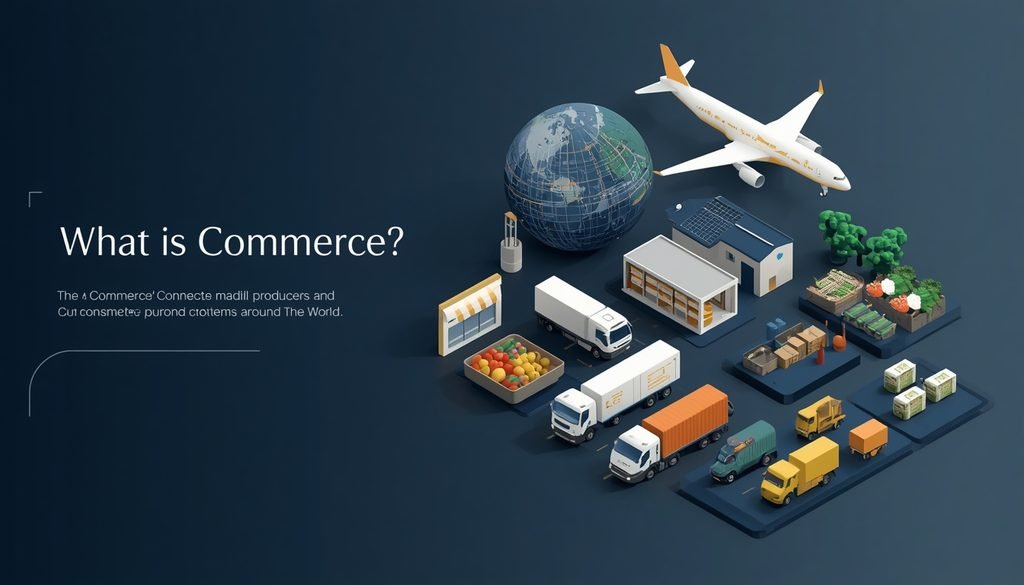
What Is Commerce? Meaning and Definition
Commerce refers to activities that facilitate the exchange of goods and services between producers and consumers. Commerce and the services that facilitate commerce are included.
In simple words, commerce helps products reach the people who need them.
Definition of Commerce
The area of business known as commerce deals with trade and the operations that make it easier for products and services to be exchanged and distributed.
For example, wheat grown by a farmer must be transported, stored and sold before it reaches consumers. These supporting activities are part of commerce.
What Are the Main Components of Commerce?
Commerce has two main components:
- Trade
- Auxiliaries to Trade
Commerce = Trade + Auxiliaries to Trade
1. Trade
The purchasing and selling of products and services, usually in return for cash, is referred to as trade.
For example, when a shopkeeper purchases products from a wholesaler and sells them to customers, trade takes place.
2. Auxiliaries to Trade
Auxiliaries to trade are services that support buying and selling and help overcome difficulties in distribution.
The main auxiliaries include:
- Transportation: It Fis the process of moving items from one location to another.
- Banking: Provides financial services and facilitates payments.
- Insurance: Protects businesses against specified risks.
- Warehousing: Stores goods until they are required.
- Advertising: Creates awareness about products.
- Communication: Helps buyers, sellers and businesses exchange information.
How Does Commerce Work in Real Life?
Imagine a company manufacturing packets of biscuits. How do they reach your neighbourhood grocery store?
- Manufacturer: Produces biscuits in a factory.
- Wholesaler: Purchases biscuits in large quantities.
- Transportation: Carries products to different markets.
- Warehousing: Stores products until required.
- Retailer: Sells products to customers.
- Consumer: Purchases the biscuits for consumption.
Banking, insurance, advertising and communication support different stages of this process.
Manufacturer → Wholesaler → Retailer → Consumer
Transportation and warehousing help products move and remain available along the way.
How Is Commerce Related to Business?
Business is a broad economic activity involving the production and distribution of goods and services. In the traditional Class 11 Business Studies framework, it has two major branches:
| Industry | Commerce |
| Concerned with production and processing | Concerned with trade and its supporting services |
Commerce connects the products of industry with their final consumers.
What Are the Nature and Characteristics of Commerce?
The main characteristics of commerce are:
1. Economic Activity
Commerce involves the exchange and distribution of goods and services, generally with the objective of earning income.
2. Involves Exchange
It includes buying and selling goods and services to satisfy people’s needs and wants.
3. Connects Producers and Consumers
It creates a link between businesses that produce goods and the people who consume them.
4. Includes Supporting Services
Commerce is broader than trade because it includes transportation, banking, insurance and other services.
5. Removes Distribution Barriers
It helps overcome difficulties related to place, time, finance, risk and information.
6. Supports Different Markets
Commerce enables businesses to exchange goods and services within their country and internationally.
What Is the Importance of Commerce?
Commerce plays an important role in business development and economic growth.
- Availability of goods: Makes products available where consumers need them.
- Employment: Creates jobs in trade, banking, transportation and insurance.
- Business growth: Helps businesses reach more customers.
- Economic development: Supports production and distribution.
- Better distribution: Facilitates the flow of commodities from producers to consumers.
- International trade: Trade between nations allows them to exchange commodities and services.
Without commerce, distributing goods and services would become much more difficult.
What Are the Functions of Commerce?
An important function of commerce is removing difficulties involved in distributing goods. In Business Studies, these difficulties are called hindrances.
| Hindrance | How it is removed |
| Persons | Trade connects producers and consumers |
| Place | Transportation moves goods |
| Time | Warehousing stores goods |
| Finance | Banking facilitates payments |
| Risk | Insurance provides protection |
| Information | Advertising and communication share information |
By removing these hindrances, commerce makes distribution easier and more efficient.
What Are the Different Types of Trade?
Based on geographical boundaries, trade is classified into two main types: internal trade and external trade.
1. Internal Trade
Internal trade refers to buying and selling goods and services within a country’s boundaries.
It has two forms:
Wholesale Trade
Purchasing goods in large quantities from producers and selling them to retailers or other businesses.
Retail Trade
Selling goods directly to final consumers, generally in smaller quantities.
2. External Trade
The exchange of commodities and services between nations is referred to as external trade. It has three forms:
Import Trade
Purchasing goods or services from another country.
Export Trade
Selling goods or services to another country.
Entrepot Trade
importing products from one nation and exporting them to another.
| Internal Trade | External Trade |
| Wholesale | Import |
| Retail | Export |
| Entrepot |
What Is the Difference Between Trade and Commerce?
Trade and commerce are related, but they have different meanings.
| Basis | Trade | Commerce |
| Meaning | Buying and selling | Trade and supporting activities |
| Scope | Narrower | Broader |
| Main focus | Exchange | Exchange and distribution |
| Examples | Buying and selling products | Trade, banking and transportation |
Trade is a part of commerce. Commerce includes trade as well as the services that facilitate it.
Commerce as a Study Stream
Commerce is a popular academic stream for students after Class 10. It helps them understand business, finance and economic activities.
The major subjects commonly associated with this stream include:
Accountancy
Deals with recording, classifying and analysing financial transactions.
Business Studies
Explains business activities, management and business organisations.
Economics
Studies how individuals, businesses and economies use limited resources.
Depending on the school and educational board, students may also study Mathematics and other optional subjects.
Frequently Asked Questions About Commerce
1. What is commerce in simple words?
Commerce involves buying and selling goods and services along with activities that help products reach consumers.
2. What are the two main components of commerce?
The two components are trade and auxiliaries to trade.
3. What are auxiliaries to trade?
Transportation, finance, insurance, warehousing, advertising, and communication are among the services that facilitate commerce.
4. What is the difference between trade and commerce?
Trade involves buying and selling, whereas commerce includes trade and its supporting services.
5. What are the main types of trade?
The two main types are internal trade and external trade.
6. Why is commerce important?
It connects producers with consumers, supports distribution, creates employment and contributes to economic development.
7. Is commerce a good stream for Class 11 students?
It can be suitable for students interested in business, finance, accounting, economics and management. The right choice depends on their interests and career goals.
Conclusion: Understanding the Meaning of Commerce
Commerce is much more than buying and selling. It includes trade and the services that help goods and services reach consumers efficiently.
From transportation and banking to insurance and advertising, these activities support the distribution process. Understanding commerce helps us see how businesses operate and how the economy works in everyday life.